

[2026 Latest] Overcoming "Training Data Shortage" with Good-Product Learning (Anomaly Detection): A Paradigm Shift in Visual Inspection Using VAE and GAN
In the implementation of AI visual inspection at manufacturing sites, the biggest barrier has been the "shortage of training data." Conventional Deep Learning required thousands of defect images, but on high-yield Japanese production lines, defects rarely occur, creating a dilemma where learning cannot progress. In this article, we will explain from a senior consultant's perspective the latest "Good-Product Learning (Anomaly Detection)" technology that detects anomalies using only non-defective data, along with 2026-edition quality management strategies utilizing VAE (Variational Autoencoders) and GAN (Generative Adversarial Networks).
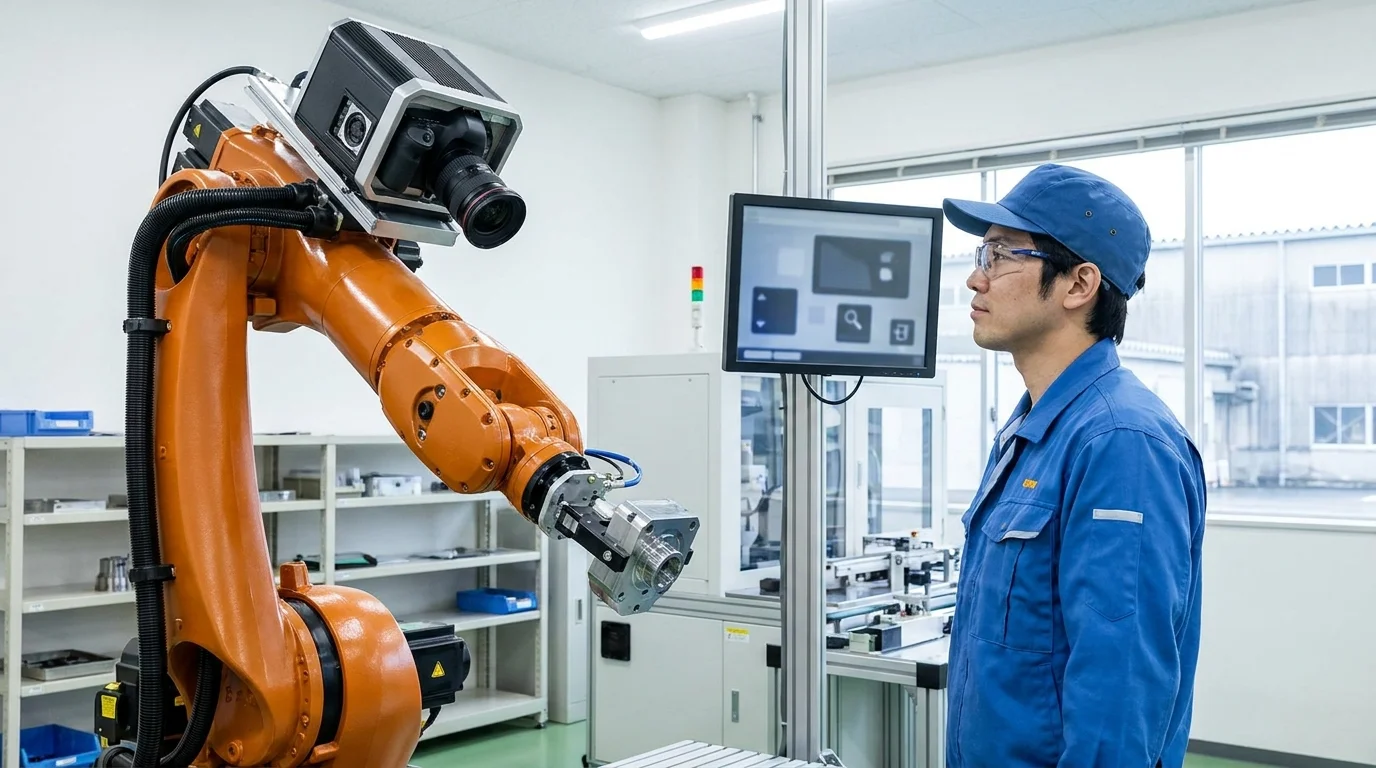
1. Why "Good-Product Learning" is Necessary: Challenges in High-Mix Low-Volume Production
Conventional "supervised learning" required a large amount of labeled ground-truth data for each defect mode, such as scratches, stains, or foreign object contamination. However, in modern manufacturing—especially in high-mix low-volume production—product cycles are short, and production often ends before sufficient defect samples can be collected. The anomaly detection method solves this challenge by learning the "normal state (distribution)" and identifying anything that deviates from it as an anomaly.
Update your company's quality control with next-generation AI
Before giving up because "AI is impossible without enough defect data," why not consider the latest anomaly detection technology?
Talk to us for a free strategy consultationSummary
AI visual inspection has completely shifted from the era of "supervised learning," which requires massive amounts of defect data, to the era of anomaly detection, which defines "normal" using only good products. With the latest architectures combining VAE, GAN, and Few-shot Learning, high ROI can be achieved early even in high-mix, low-volume production environments. Instead of viewing data scarcity as a hurdle, turn the latest algorithms into your weapon and take the first step toward building a next-generation smart factory.
Published: June 4, 2026 / By: Osamu Yasuda

Related Articles



References
- [1] Kingma, D. P., & Welling, M. (2013). Auto-Encoding Variational Bayes.
- [2] Goodfellow, I., et al. (2014). Generative Adversarial Nets.
- [3] AI Visual Inspection Market Forecast in Japanese Manufacturing 2026 (Meets Consulting Research Report)